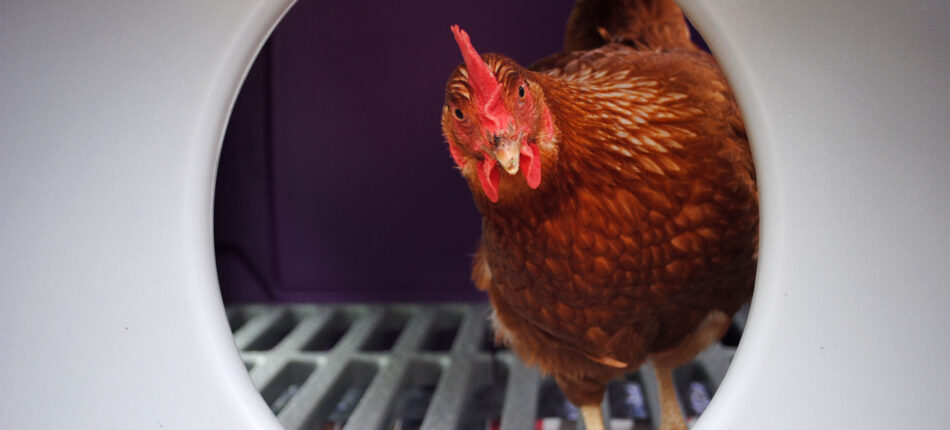
Have you ever wondered what’s going on in the minds of your chickens?
Chickens have, just like us, full-colour vision. So the colourful Eglus from Omlet will also brighten up your chickens’ day!
Chickens dream just like we do. During sleep they also experience REM (Rapid Egg Movement?). Maybe they dream about all the exciting things they did during the day…
Chickens are omnivores, which means they eat both vegetables and meat. They love seeds and juicy worms, but will also appreciate a small mouse if they come across one.
Chickens are related to the Tyrannosaurus rex. Maybe this is not that hard to believe when they stare at you with a penetrating gaze (trying to convince you to feed them…again!).
There is a word for the extreme fear of chickens, namely alektorophobia.
People with alektorophobia can even develop a fear for eggs.
Chickens have an excellent memory. They are able to recognise the faces of more than 100 members of their species, other animals and humans.
Wild chickens just lay ten to fifteen eggs a year during the breeding season. Battery hens are bred to lay an egg almost every day. To make sure you’ll use the eggs of your hens in date order, Omlet provides the Egg Date Stamping Kit, the Egg Skelter and Egg Ramp
The heaviest chicken egg ever weighed was 340g (as a comparison: an average chicken egg weighs between 55-75g). As chickens get older they will lay fewer but larger eggs.
The colour of the egg does not alter its nutritional value or taste. The reasoning behind different shell colours is that different breeds lay eggs of different colours.
It takes 21 days on average for a chicken egg to hatch once incubation begins, whether you incubate them with an incubator or set them under a hen.
It is very unlikely that an egg with a double yolk will produce a chicken twin. There is too little space in the egg for two chicks to fully develop.
Worldwide there are more than 25 billion chickens (as a comparison: there are less than 7.5 billion people). Chickens are therefore the most common birds on earth.
The red junglefowl (gallus gallus) from Asia is the ancestor of the modern chicken (Gallus gallus domesticus). Chickens were probably already domesticated in the sixth millenium B.C.
By clicking "Accept All", you agree to the storing of cookies on your device to enhance site navigation, analyze site usage, and assist in our marketing efforts.
Privacy Preference Centre
When you visit any website, it may store or retrieve information on your browser, mostly in the form of cookies. This information might be about you, your preferences or your device and is mostly used to make the site work as you expect it to. The information does not usually directly identify you, but it can give you a more personalized web experience. Because we respect your right to privacy, you can choose not to allow some types of cookies. Click on the different category headings to find out more and change our default settings. However, blocking some types of cookies may impact your experience of the site and the services we are able to offer.
Manage Consent Preferences
Always Active
These cookies are necessary for the website to function and cannot be switched off in our systems. They are usually only set in response to actions made by you which amount to a request for services, such as setting your privacy preferences, logging in or filling in forms. You can set your browser to block or alert you about these cookies, but some parts of the site will not then work. These cookies do not store any personally identifiable information.
These cookies allow us to count visits and traffic sources so we can measure and improve the performance of our site. They help us to know which pages are the most and least popular and see how visitors move around the site. All information these cookies collect is aggregated and therefore anonymous. If you do not allow these cookies we will not know when you have visited our site, and will not be able to monitor its performance.
These cookies enable the website to provide enhanced functionality and personalisation. They may be set by us or by third party providers whose services we have added to our pages. If you do not allow these cookies then some or all of these services may not function properly.
These cookies may be set through our site by our advertising partners. They may be used by those companies to build a profile of your interests and show you relevant adverts on other sites. They do not store directly personal information, but are based on uniquely identifying your browser and internet device. If you do not allow these cookies, you will experience less targeted advertising.
 Free returns
  180-day guarantee
  10% off your first order